
WEEPING CROSS TREE
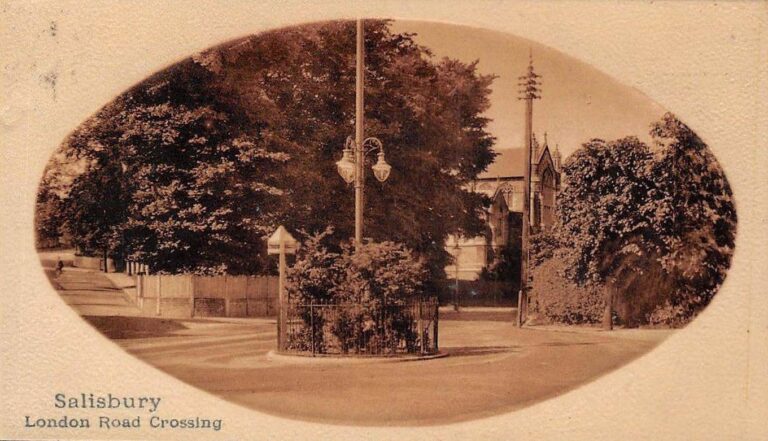
The name Weeping Cross Tree has often appeared during my researches and it has been said that this area, which was situated near St. Mark’s Church, Salisbury, was also known as Whipping Cross Tree.
An early reference to the Weeping Cross Tree was found in the Quarter Sessions Rolls from 1617 and the name is repeated on Naish’s map of 1716 – it was also referred to on J.C. Botham’s map published in 1860. George Oakley Lucas’s map of the 1830s mentions it as the Whipping or Weeping Cross Tree and perhaps this is where the confusion started. However, I find it difficult to believe the notion that this tree was used for the purpose of whipping convicts (as some have speculated). A far more likely explanation is that it was here that the horse drawn coach stopped for passengers bound for London and the ‘weeping’ was in response to a sad farewell. It is interesting to note this 19th century explanation written by Edward Duke.
“…Think you, that it was the Whipping-cross, where the convicted sinners before the temporal authorities were taken, in days of yore, for the purposes of castigation, and that its appellation has been corrupted to that of Whipping-cross? No! – the rulers of the city would never have moved the culprit to the distant Cross – they would have inflicted this chastening correction within the view of those, who should be warned by the salutary example of vengeance. It is very true, that the effect doth follow the cause – that weeping, for the most part, doth follow whipping; but, verily, I believe, that these crosses were raised for the former purpose alone. In those early days, the perils of the roads were great – the ways were rough, and miry, and the travelling thereon was slow, and toilsome. They were also beset with the vile, and the wicked – with those, who lay in wait to rob, and to plunder, and mayhap – to cut the throat of that unhappy wight, who might, perchance, adventure within their chosen limit. No wonder, therefore, that a journey to the far-famed, and great London Town should call forth the feeling sympathies of relations near, and dear; no wonder, that the loving wife – the doting mother – the betrothed fair-one – the fond children – the kind sisters – should accompany the adventuresome husband – son – lover – father – or brother (for females did travel not in those dread days) even to the Weeping-cross, out of town, and there piously, and affectionately, did bid “farewell,” with many tears and sighs, to him, who was about to leave them in sadness, and uncertainty, as to his fate, and welfare. Gentle Reader! Cannot you picture to yourself the interesting family group, kneeling around this Weeping-cross, repeating their Ave-Marias, and soliciting benedictions, and safety, for him, from whom they were about to depart, and to leave – perhaps – for ever! But I must close this interesting – this heart-rending scene!
Further reference to Weeping Cross Tree is recorded in the marvellous book,
‘The Spinster At Home In The Close’ by Miss Child in 1844:
….Where such a cross stood, – now an ancient tree grows,
Whose curious cognomen, an old custom shows.
This famed Weeping-Cross was the scene of sad grief,
When disconsolate friends at its foot sought relief:
For here it was common to accompany those
Who on some journey bound, might encounter strange foes,
Or be thrown from their horses on hard-hearted stones
And receive bad contusions, if not broken bones
Another reference from 1887 states that: “At a spot called “Weeping Cross” or “Weeping Cross Tree” is a piece of ground that some two or three years ago was in a very disreputable state. This fell under the notice of Mr F Griffin who undertook to bear the expense of having it put into order and the change was highly pleasing.”
By the 1920s, Weeping Cross Tree was looking neglected and had fallen into a very bad condition. As it was situated on land which belonged to St Mark’s Church, a suggestion was made in 1924 to the Parochial Church indicating that if they passed the area over to the Town Council, they would tidy up the tree and erect a seat. This was duly agreed and the ownership was passed over to the City Corporation. But still the complaints came. In 1929 the state of the seat was highlighted and the public were also concerned about the safety of the tree.
In 1932 the Council were asked to remove the two lowest branches of the tree because the public had reported a number of accidents involving children climbing the tree. The concerned Vicar of St Mark’s asked for the tree to be removed altogether along with the fence which surrounded it – there was, he said, danger that children might be impaled on the spiked fence. After much discussion, the tree was finally cut down and a proposal was brought forward to provide a plaque for the seat giving a brief historical description of the Weeping Cross Tree. Many people were unhappy with the removal of the tree and even more so when the council turned down the idea of a plaque in the tree’s memory. The following are two suggestions for wording on the plaque which appeared in the Salisbury Journal:
Stop, traveller, and shed a tear,
Our storied tree’s no longer here!
Come, sit with me and mourn the loss
Of all that stood for Weeping Cross.
The second was more scathing!
Some wish to destroy all links with the past,
But, surely, they’ll keep the best cuts to the last,
And, finally, crown all their labour and pains
By hanging the Mayor and Council in chains.
The construction of Churchill Way changed the area of Weeping Cross forever and with it went a remarkable history from a bygone age.