
Frogg Moody’s series of Salisbury Personalities
No 2. HENRY FAWCETT
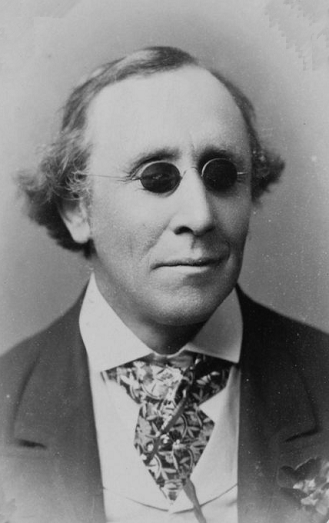
In the second in this series, we look at the life of The Right. Hon. Henry Fawcett, the blind Postmaster General and member of Mr.Gladstone’s administration.
A statue to this distinguished statesman stands in Salisbury Market Square opposite the site of the house in which he was born, the son of Mayor William Fawcett, on August 26th, 1833. The family then consisted of an older brother William, a sister Sarah Maria, and subsequently of another brother Thomas Cooper. On September
15th, 1858, when out shooting on Harnham Hill, his father, who was rather short-sighted, fired at a partridge and brought it down.
Unfortunately he did not see who was in the line of fire, and some straying shot penetrated both of his son’s eyes, blinding him instantly. It happened, however, that the son’s sight was not good, and to protect it he was wearing tinted spectacles. Both glasses were pierced but the resistance which they offered to the shot prevented the charge entering the brain and probably ending his life.
In “A Beacon for the Blind,” a volume dealing admiringly, as well it may, with the great career that followed, Miss Winifred Holt, after relating the incident, says:
“He was taken back to his father’s house in a cart, and his first words to his sister as she received him were, “Maria, will you read the newspaper to me…?” In this crisis his sister Maria was a tower of strength. The poor father seemed more sorely stricken by the accident than the son. But for his daughter’s wisdom the father would probably have lost his reason. All through the night Maria kept him busy at small, useful tasks,
and for several days occupied both her mother and him as fully as possible.”
After a lapse of six weeks Fawcett was able for three day’s to perceive light, but after that the curtains fell for the rest of his life, and he remained in total darkness. Nevertheless he maintained his extraordinary interest in sport, particularly fishing and skating, and pursued his ambition to enter public life until he was elected Liberal
M.P. for Brighton. It is related that after his marriage he spent his honeymoon at Alderbury – a place that had been familiar to him when he was there as a schoolboy (possibly at the private school at Ivy Church, kept by a friend of Dickens), and each day he took his bride on some new and lovely drive, stopping on the way to show
her the views which he loved and so well remembered.
“A Beacon for the Blind,” also tells an interesting story which relates to the old custom of nightly closing the gates of the Close. “As Henry liked to walk the last thing at night before going to bed, it was arranged for him to go with the gate-closer on his rounds. So, regularly, when Henry was at home, the gate-closer’s voice would
be heard at 10.30pm (the gates were shut then regularly at 11.00pm): “I’ve come for Mr. Harry!”, and together they would sally forth and lock the ancient gates.”
Henry Fawcett (1833-1884) was blinded in a shooting accident aged 25. He was elected Liberal MP for first Brighton and later Hackney from 1865. Always a supporter of votes for women, Henry Fawcett supported John Stuart Mill in the first debate on votes for women in the House of Commons in 1867. Henry Fawcett
married Millicent Garrett in 1867 and she acted as his eyes in Parliament until his death.