
Frogg Moody’s series of Salisbury Personalities
No 1. SETH WARD
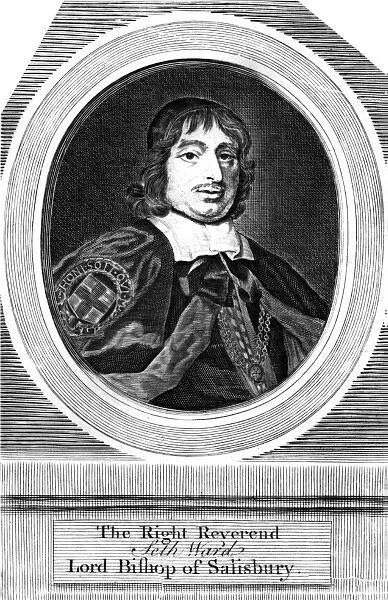
Seth Ward was born in 1617 in Hertfordshire, and while still at school was distinguished for his intellectual ability. At the age of 15 he went up to Cambridge, where after being a Fellow of Sidney Sussex College in 1640, he became in 1643 Lecturer in Mathematics – a subject of which little was known there at that time.
The next year he was expelled from his Fellowship for his loyalty to Charles I. But in 1648 he was strongly recommended as successor to the expelled Professor of Astronomy at Oxford, and through the support of a friend who was a Parliamentarian obtained this post. He was Savilian Professor of Astronomy there from 1648 to 1660.
During this time his lectures on astronomy became well-known, and he published three books on astronomy and Mathematics. His main work consisted of an improved theory of the elliptical nature of planetary orbits. At the same time he became notable as a preacher, and produced a book on “The Being and Attributes of God,” etc.
While at Oxford he was a Fellow of Wadham College, and there he was one of a number of distinguished men at this College who met together in “The Philosophical Society of Oxford,” which was one of two small groups from which arose after 1660 the world-famous Royal Society. Seth Ward was thus one of the pioneers of science in England, a founder-member, and the close friend of Robert Boyle, Isaac Barrow (who was later his Chaplain at Salisbury and a canon of the Cathedral), Sir Christopher Wren, Sir Isaac Newton and other great scientists of the XVIIth century.
In 1671 it was Seth Ward who proposed Newton as a Fellow of the Royal Society. Ward gave up his Professorship in 1660, to become Precentor of Exeter (he was a keen musician); in 1661 he was made Dean of Exeter; in 1662 he was appointed Bishop of Exeter and in 1667 Bishop of Salisbury.
At Exeter he did great work in restoring the Cathedral and Palace at a cost of £25,000, and in raising money to increase the stipends of poor clergy. He was an able business man, a good administrator, a great preacher, and famed for his hospitality and generosity. He founded the Matrons College in the Close for the widows of clergy in his two dioceses. He supported strong measures against Dissenters whom he suspected of disloyalty to the King and of producing dissention in the state; but he respected genuine piety and sincerity in individual Dissenters. His scientific interests also included the collection of a number of strange recipes for medicines.